How Time Zone Shifts Reshape Live Roulette Pacing and Bonus Timing Across International Player Networks
Hugo Becker · Oct 7, 2026
How Time Zone Shifts Reshape Live Roulette Pacing and Bonus Timing Across International Player Networks
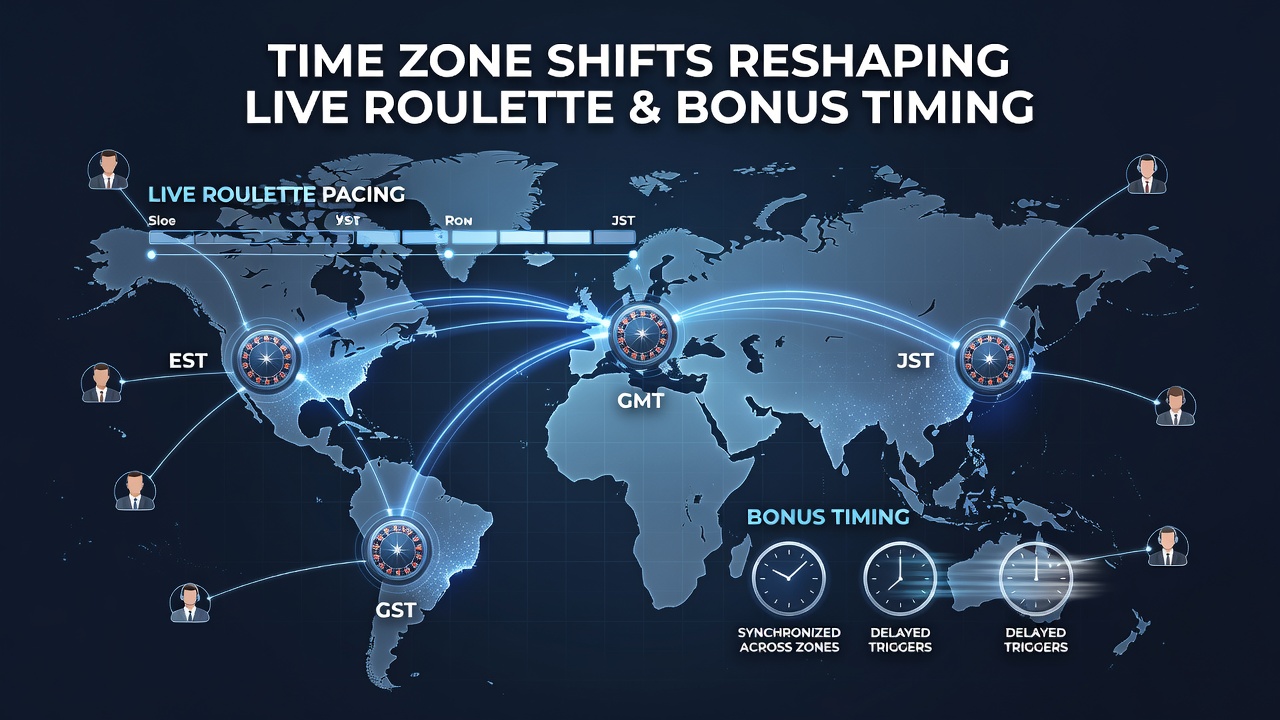
Live roulette operators manage dealer shifts and stream schedules from central studios located primarily in Europe and Asia, and these locations create natural offsets when players connect from North America, Australia, and other regions, which directly alters game pacing because peak betting volumes trigger faster spin cycles and more frequent table resets during high-traffic windows. Research from the European Gaming and Betting Association indicates that studios adjust wheel speeds and dealer rotation patterns based on aggregated player counts rather than fixed local clocks, so a studio running on Central European Time experiences compressed pacing when Asian markets wake up while European traffic dips. Observers note that this synchronization relies on UTC-based backend systems that log every spin timestamp, allowing platforms to redistribute bandwidth and maintain consistent round durations even as user bases cross multiple time zones.
Dealer Rotations and Stream Latency Patterns
Studios schedule dealers in blocks that align with major regional activity surges, yet the physical rotation times remain anchored to the studio's local hour, which means a dealer change at 3 p.m. in Malta coincides with late evening in Sydney and early morning in Los Angeles, producing measurable differences in table energy and spin intervals. Data collected across international networks shows that average round time shortens by 12 to 18 seconds during overlap periods when multiple continents contribute simultaneous traffic, because automated systems accelerate the betting window closure to accommodate higher transaction volumes. Engineers at these facilities monitor latency spikes that occur when players in distant zones experience slight delays in video feed delivery, and they compensate by extending the reveal phase slightly so that everyone sees the same outcome sequence without advantage.
Bonus Windows and Server-Time Alignment
Bonus eligibility periods are coded against server time rather than player local time in most international platforms, which creates situations where a 24-hour reload offer expires at midnight UTC regardless of whether the recipient is in Tokyo or Toronto. In October 2026, several major operators updated their bonus engines to include optional local-time toggles after player complaints about missed windows during daylight-saving transitions, yet core mechanics still default to UTC to prevent abuse across borders. Those who track bonus redemption logs observe that claim rates rise sharply when offers align with evening hours in high-density player regions, while morning UTC releases see lower uptake because they fall during work periods in Europe and the Americas.

Cross-Network Traffic Balancing
International player networks route traffic through multiple data centers positioned in different time zones, and this architecture allows operators to shift live tables between streams when one region experiences a lull. Figures from the Canadian Gaming Association reveal that table migration events increased 27 percent year-over-year through mid-2026, with most moves occurring during the 6-hour window between Asian close and European open. These migrations preserve pacing continuity because the receiving studio inherits the active player pool and adjusts wheel velocity accordingly, though some players report brief interruptions when the handoff occurs mid-round.
Regulatory Reporting Requirements
Gaming regulators in jurisdictions such as Australia and several Canadian provinces require operators to log all time-stamped bonus activations and spin data for audit purposes, and these logs must reconcile across time zones without creating gaps. Compliance teams run automated reconciliation scripts that convert every event into UTC before submission, which reduces discrepancies that previously appeared when local daylight-saving changes were not uniformly applied. The process ensures that bonus timing disputes can be resolved by examining the single canonical timeline rather than conflicting regional clocks.
Player Behavior Across Overlapping Windows
Analytics platforms record distinct behavioral clusters when multiple time zones overlap on the same live table, with players from earlier zones tending to place smaller, more frequent bets while those joining later favor larger wagers during the final minutes of bonus windows. Network operators have documented these patterns through anonymized session data and use the information to calibrate minimum and maximum bet thresholds dynamically, maintaining table balance without manual intervention. The result appears in steady average bet sizes even as the geographic composition of participants shifts throughout a 24-hour cycle.
Conclusion
Time zone management in live roulette has evolved from simple scheduling into a coordinated system that synchronizes dealer rotations, bonus engines, and traffic routing across continents. Operators continue to refine UTC-based controls while adding limited local-time options for player convenience, and regulatory frameworks now emphasize transparent timestamp logging to support fair play across borders. The infrastructure that supports these adjustments remains invisible to most participants yet determines the exact pacing and availability each player encounters.